
Most ecommerce prospecting systems become inefficient long before teams notice the problem.
The issue usually is not lead volume. The issue is list quality.
What Is Ecommerce Prospecting?
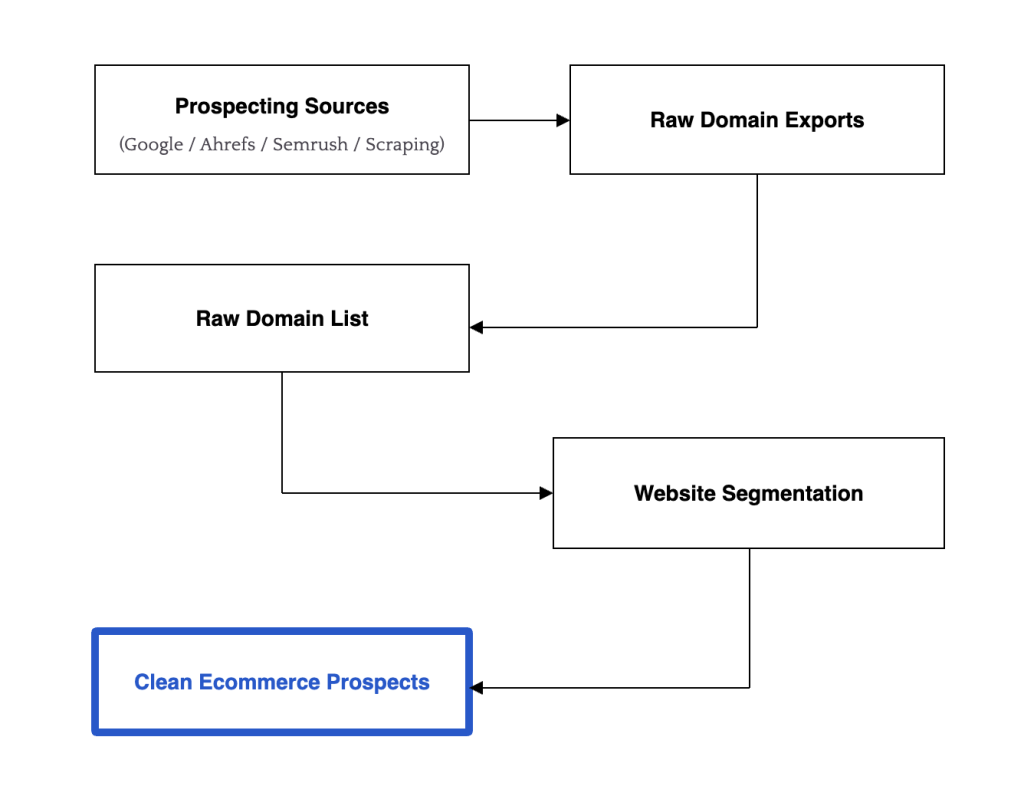
Ecommerce prospecting is the process of identifying ecommerce businesses for outreach, lead generation, partnerships, sales campaigns, or market research. Raw ecommerce prospect lists often contain mixed website types, which creates filtering and segmentation problems at scale.
Agencies, sales teams, and outbound operators often collect thousands of domains from Ahrefs, Google search results, ecommerce directories, competitor backlink exports, Shopify footprint searches, and marketplace scraping workflows.
But raw prospect exports rarely contain only ecommerce websites.
They usually contain a mix of:
- ecommerce stores
- blogs
- affiliate websites
- marketing agencies
- media sites
- marketplaces
- company websites
- abandoned domains
That creates a filtering problem. And at scale, filtering becomes an operational bottleneck. Especially in cases where the goal is to identify ecommerce websites or only Shopify stores within a specific niche, such as travel or home and living.
Ecommerce Prospect Lists Often Contain Mixed Website Types
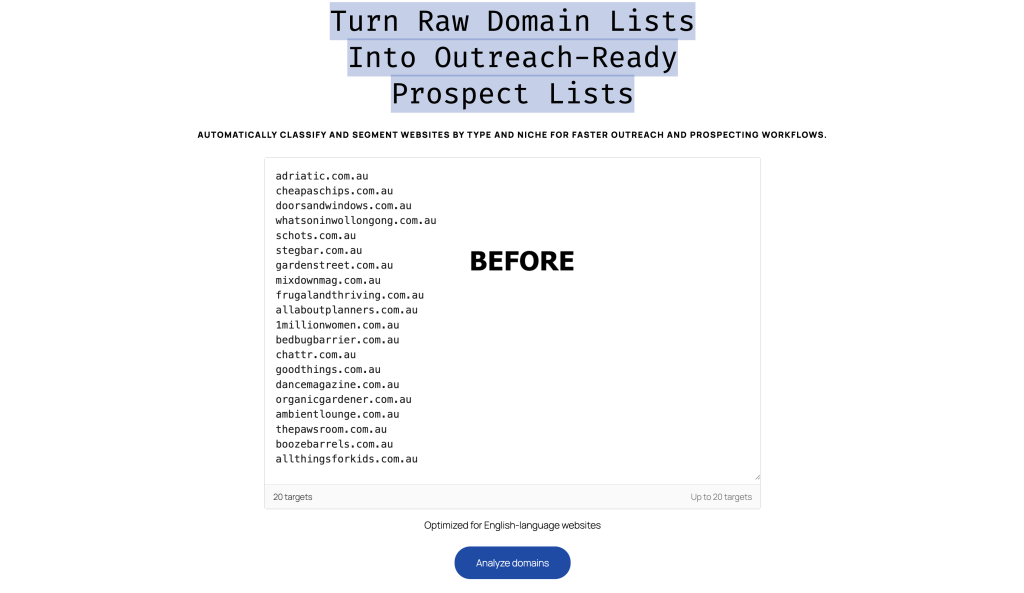
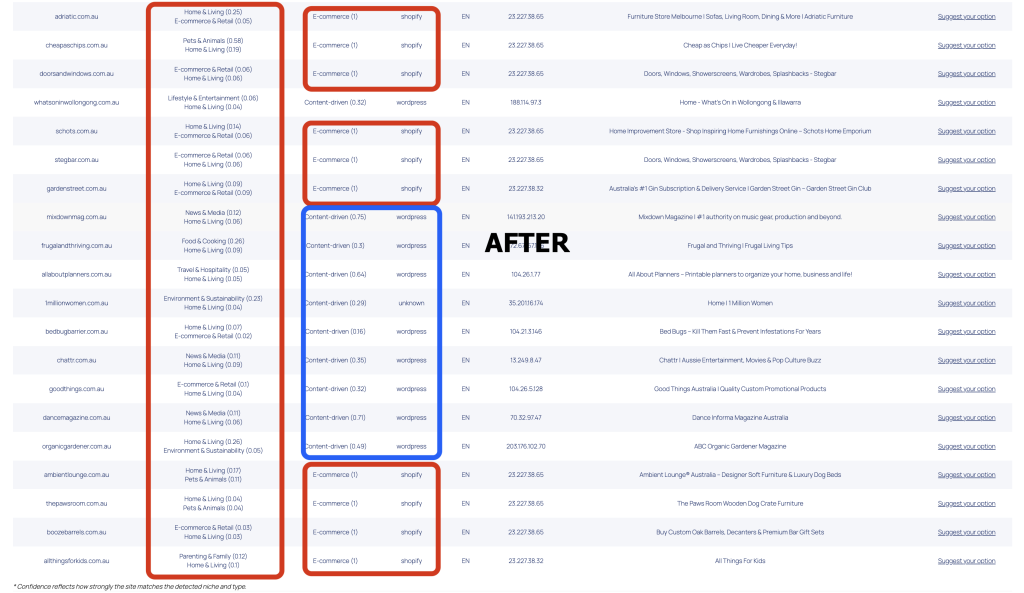
This is one of the most overlooked problems in ecommerce lead generation workflows.
Teams assume they are building lists of ecommerce brands.
In reality, they are building lists of domains only loosely connected to ecommerce-related keywords.
Those are not the same thing.
For example, if you are searching for Shopify stores in the home and living niche on Australian domains, the results may include:
- real DTC brands selling products directly to consumers
- gardening blogs
- Amazon reseller pages
- ecommerce SaaS tools
- fulfillment service providers
- influencer websites
- agencies working with ecommerce brands
- wholesale marketplaces
The larger the export becomes, the worse the segmentation problem gets.
This is especially common in:
- Shopify store discovery
- DTC brand prospecting
- ecommerce backlink analysis
- outbound ecommerce lead generation
- ecommerce niche research
The prospecting system starts producing volume without producing clarity.
Why Ecommerce Prospecting Becomes Messy at Scale
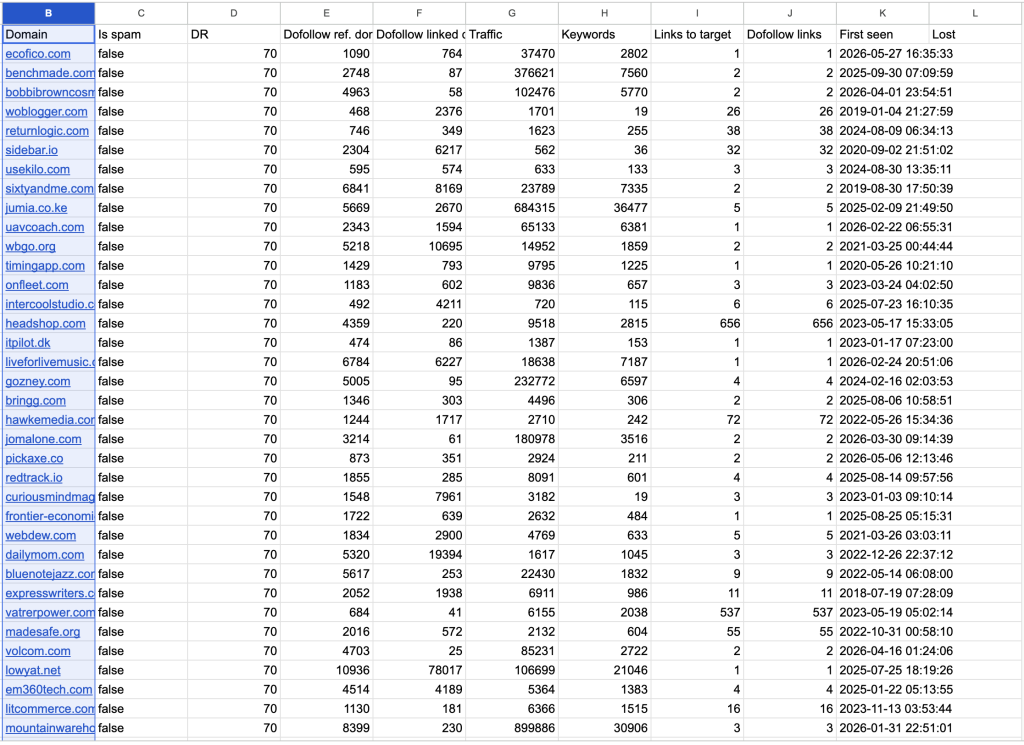
Small prospect lists can be reviewed manually.
Large prospect lists cannot.
That is where operational problems begin.
A sales team reviewing 50 domains manually may spend a few minutes filtering irrelevant websites.
A team reviewing 30,000 domains cannot realistically operate that way.
Manual prospect filtering becomes inefficient at scale.
That inefficiency compounds across the workflow:
- irrelevant domains enter the pipeline
- outreach lists become bloated
- sales teams waste review time
- lead quality becomes inconsistent
- campaign targeting weakens
- outbound personalization suffers
Eventually, the workflow slows down because humans become the classification layer.
That is expensive operationally.
Raw Domain Exports Are Usually Structurally Noisy
Most ecommerce lead generation workflows rely on imperfect source data.
Common prospecting sources include:
Ahrefs Competitor Exports
Agencies often export referring domains from competing ecommerce brands.
The assumption is simple:
“If competitors received links from these domains, some of those domains may contain ecommerce companies.”
But backlink exports usually contain many unrelated website types.
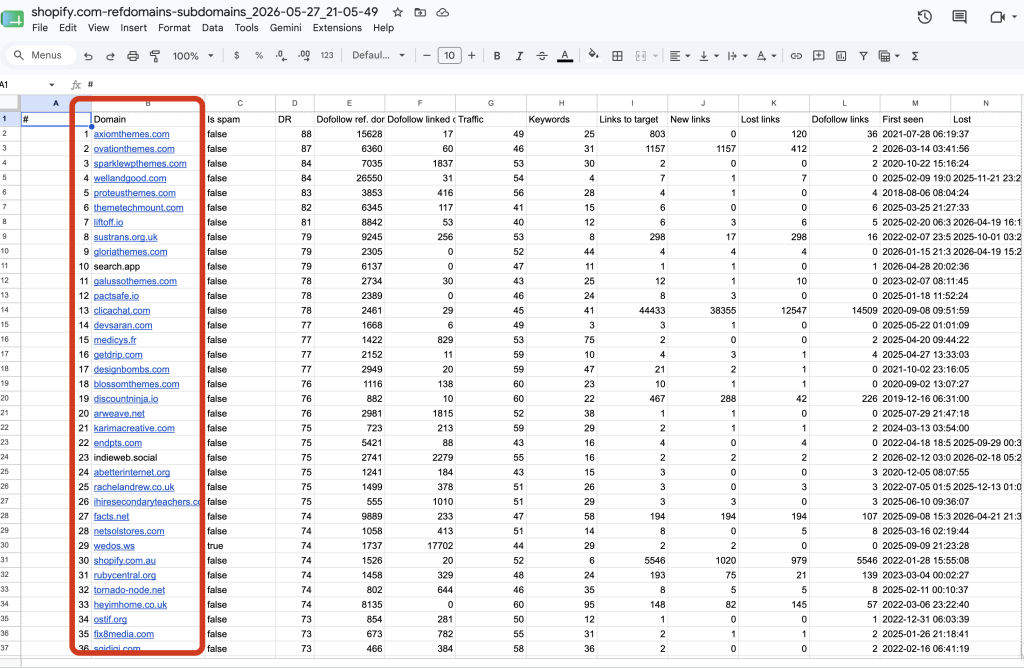
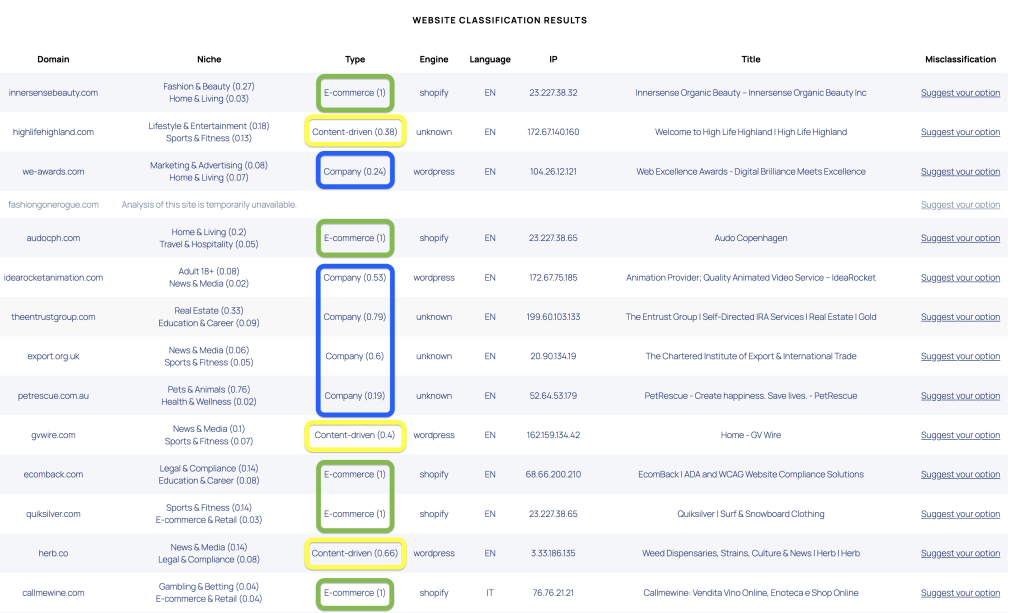
For example, as shown in the image, even when the export is expected to contain primarily ecommerce websites, the dataset may still include many other website types.
These often include company websites as well as content-driven websites such as news media publications, blogs, magazines, and similar editorial websites.
Without filtering, outreach teams inherit mixed datasets.
Google Search Scraping
Many ecommerce prospecting workflows rely on search operators such as:
- “powered by Shopify”
- “buy now”
- “cart”
- niche + “store”
- niche + “shop”
This helps discover ecommerce websites quickly.
But search results still contain informational pages, software companies, and marketplaces mixed into the results. Moreover, search visibility alone does not help define the actual niche relevance of a website.
Search intent does not guarantee website type consistency.
Ecommerce Directories
Directories create another operational problem.
Some directories mix:
- manufacturers
- distributors
- wholesalers
- blogs
- SaaS tools
- ecommerce brands
into the same category structure. The export looks clean initially.
Operationally, it is not.
Marketplace Adjacency Problems
Large marketplaces distort ecommerce prospecting datasets.
For example:
- Etsy sellers
- Amazon storefronts
- marketplace profile pages
- aggregator domains
often appear alongside independent ecommerce brands.
These businesses operate differently from standalone DTC stores.
Treating them identically creates targeting problems later in outreach workflows.
Common Website Types Found Inside Ecommerce Exports
Ecommerce exports rarely contain only ecommerce stores.
This is one reason ecommerce website detection matters operationally.
Common website categories inside raw exports include:
| Website Type | Usually Useful? | Common Problem |
|---|---|---|
| Shopify stores | Yes | Often buried inside mixed exports |
| WooCommerce stores | Yes | Harder to detect consistently |
| Content-driven blogs | Sometimes | Frequently mistaken for stores |
| Companies | No | Often rank for ecommerce keywords |
| Agencies | Usually no | Pollute lead lists |
| Marketplaces | Depends | Different sales dynamics |
| Affiliate websites | Rarely | Low outbound relevance |
| Media sites | Rarely | Not ecommerce buyers |
| Corporate websites | Sometimes | May not sell directly |
Website classification helps separate these categories before outreach begins.
That changes the efficiency of the entire workflow.
Why Manual Filtering Fails Operationally
Manual filtering works poorly because humans are inconsistent classifiers.
Two team members reviewing the same domain often categorize it differently.
That creates:
- inconsistent segmentation
- uneven lead quality
- unreliable outreach prioritization
- duplicated review work
The problem becomes worse when prospecting teams scale across:
- multiple niches
- multiple geographies
- multilingual websites
- international ecommerce markets
A prospecting workflow that depends entirely on manual review eventually becomes difficult to maintain.
The issue is not effort.
The issue is structural inefficiency.
How Agencies Structure Ecommerce Lead Workflows
Experienced outreach and lead generation teams usually build layered prospecting systems.
The workflow often looks something like this.
1. Raw Lead Collection
Teams gather domains from multiple sources:
- Ahrefs exports
- Google scraping
- ecommerce directories
- competitor research
- Shopify footprint searches
- marketplace analysis
- LinkedIn research
- niche-specific searches
At this stage, the dataset is intentionally broad.
The goal is coverage, not precision.
2. Website Classification
This is where operational prospecting starts becoming useful.
Teams separate domains into categories such as:
- ecommerce stores
- content websites (Magazines/Blogs/News and so on)
- agencies (SEO/Marketing agencies)
- companies (local business, Saas, and so on)
Website classification reduces downstream filtering work.
Instead of manually reviewing every domain later, teams segment the dataset early.
This is operationally faster.
3. Ecommerce Website Detection
Not all ecommerce stores are equal.
Agencies often prioritize:
- Shopify stores
- DTC brands
- independently operated ecommerce websites
- fast-growing niche stores
Some workflows also detect:
- ecommerce platform technology
- language
- niche relevance
- country targeting
This helps prioritize outbound campaigns.
4. Segmentation by Niche
Large ecommerce lists become more useful after segmentation.
For example:
- pet and animals
- fashion and beauty
- health and wellness
- home and living
- tech and software
In practice, niche segmentation improves:
- personalization
- outreach relevance
- sales messaging
- campaign targeting
5. Prospect Prioritization
After filtering and segmentation, teams usually prioritize:
- real ecommerce operators
- actively maintained stores
- growing DTC brands
- stores with visible acquisition intent
The final outreach list becomes significantly cleaner than the original export.
Shopify Stores Are Structurally Different From Content-Driven Websites
Content-driven websites are websites primarily built around editorial content such as articles, guides, news, reviews, or educational resources.These websites differ structurally from ecommerce stores because their primary goal is traffic acquisition rather than transactions.
This distinction matters more than many prospecting systems assume.
Content websites optimize for traffic.
Ecommerce stores optimize for transactions.
Their operational signals differ:
| Content Websites | Ecommerce Stores |
|---|---|
| article-heavy structure | product-heavy structure |
| informational intent | transactional intent |
| large blog archives | product catalogs |
| editorial navigation | shopping navigation |
| ad monetization | checkout flows |
Shopify stores are structurally different from content-driven websites.
That difference becomes important in:
- lead qualification
- outreach targeting
- partnership prospecting
- ecommerce sales workflows
How Website Classification Improves Prospecting Workflows
Website classification acts as a filtering layer between raw exports and outreach execution.
Instead of treating all domains equally, the workflow becomes segmented.
Before classification:
- mixed exports
- irrelevant websites
- inconsistent reviews
- bloated outreach lists
- high manual workload
After classification:
- segmented ecommerce lists
- grouped Shopify stores
- cleaner prospect pipelines
- reduced manual review
- more consistent targeting
Practically, this improves workflow speed more than most teams expect.
Especially at scale.
How SiteTypes.com Was Created Internally
SiteTypes started as an internal operational utility. The original problem was simple: large prospect exports were taking too long to clean manually.
The workflow problem repeated constantly across:
- outreach campaigns
- ecommerce prospecting
- DTC brand discovery
- lead generation research
- backlink prospecting
Most exports contained mixed website types.
Teams were spending hours manually identifying:
- which domains were ecommerce stores
- which were blogs
- which were agencies
- which were companies
- which were marketplaces
The process became repetitive. SiteTypes was built to reduce that manual segmentation work. Not as an enterprise SaaS platform. Not as an “AI commerce intelligence engine.”
Just as a practical classification utility for operational workflows.
The core purpose was straightforward: separate website types before outreach begins.
Ecommerce Website Detection Changes Workflow Economics
Cleaner prospect lists create operational advantages.
Not theoretical advantages.
Practical ones.
When ecommerce lists become cleaner:
- outreach teams spend less time reviewing domains
- personalization becomes easier
- lead quality becomes more consistent
- segmentation improves
- campaign targeting becomes narrower
- outbound workflows move faster
The benefit compounds over time because the workflow itself becomes more structured.
Operationally, structured prospecting systems outperform chaotic ones.
Especially when teams scale lead generation across large datasets.
Ecommerce Prospecting Is Mostly a Segmentation Problem
Many teams assume ecommerce prospecting is primarily a discovery problem.
Often it is actually a segmentation problem. Finding domains is relatively easy.
Separating useful ecommerce websites from irrelevant domains is harder.
That distinction becomes obvious when prospect datasets grow into thousands or millions of domains.
At that scale:
- manual review slows down
- outreach quality declines
- lead consistency weakens
- operations become noisy
Website classification helps reduce that operational noise.
That is why many agencies eventually build internal filtering systems for ecommerce lead generation workflows.
Because prospect quality usually improves more from cleaner segmentation than from larger exports.
And in ecommerce prospecting, cleaner inputs often produce better outreach outcomes than bigger lists ever do.